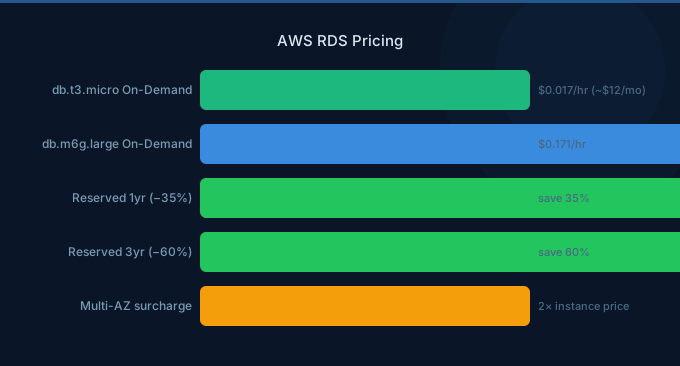
RDS is the managed database service most AWS customers never think about optimizing — until the bill arrives. A single db.r6g.2xlarge PostgreSQL instance with Multi-AZ, 500GB storage, and backups can quietly cost $1,400/month. And most companies run 3-10 RDS instances.
The pricing has four components that add up fast: instance hours, storage, I/O (for Aurora), and backups. Miss any one of these and your estimate will be wrong. Add Extended Support for older engine versions, and costs can double starting in 2026.
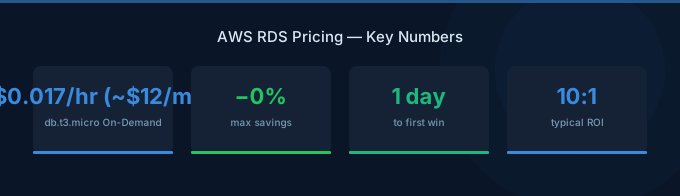
TL;DR: A db.t3.medium MySQL instance costs ~$52/month On-Demand in US East. Multi-AZ doubles the instance cost. Reserved Instances save up to 69% with a 3-year All Upfront commitment. New Database Savings Plans (launched re:Invent 2025) offer up to 35% off serverless database workloads. The free tier gives you 750 hours/month of db.t3.micro for 12 months.
RDS Instance Pricing
RDS charges by the instance-hour. Pricing varies by engine, instance type, and whether you enable Multi-AZ:
Common Instance Prices (MySQL/PostgreSQL, US East)
| Instance | vCPUs | RAM | On-Demand $/hr | ~$/Month | Multi-AZ $/Month |
|---|---|---|---|---|---|
| db.t3.micro | 2 | 1 GiB | $0.017 | $12.41 | $24.82 |
| db.t3.small | 2 | 2 GiB | $0.034 | $24.82 | $49.64 |
| db.t3.medium | 2 | 4 GiB | $0.068 | $49.64 | $99.28 |
| db.t3.large | 2 | 8 GiB | $0.136 | $99.28 | $198.56 |
| db.r6g.large | 2 | 16 GiB | $0.260 | $189.80 | $379.60 |
| db.r6g.xlarge | 4 | 32 GiB | $0.520 | $379.60 | $759.20 |
| db.r6g.2xlarge | 8 | 64 GiB | $1.040 | $759.20 | $1,518.40 |
Engine Price Differences
Not all engines cost the same for the same instance type:
| Engine | db.r6g.large $/hr | Notes |
|---|---|---|
| MySQL | $0.260 | Open-source, cheapest |
| PostgreSQL | $0.260 | Same as MySQL |
| MariaDB | $0.260 | Same as MySQL |
| Oracle (BYOL) | $0.260 | Bring Your Own License |
| Oracle (License Included) | $0.520+ | 2x+ due to Oracle licensing |
| SQL Server (Express) | $0.260 | Free edition |
| SQL Server (Standard) | $0.760+ | Microsoft licensing adds ~$0.50/hr |
| SQL Server (Enterprise) | $2.80+ | Highest cost, enterprise licensing |
Key insight: MySQL, PostgreSQL, and MariaDB all cost the same on RDS. The price difference only matters when you're running Oracle or SQL Server with included licensing — which can 2-10x the instance cost.
Multi-AZ: Double the Cost, Essential for Production
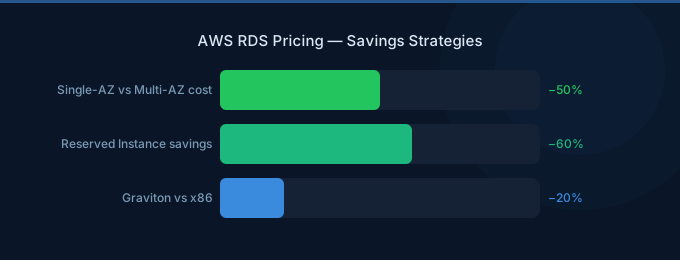
Multi-AZ creates a standby replica in a different Availability Zone for automatic failover. The standby instance runs continuously, so your instance cost doubles.
When to use Multi-AZ:
- Production databases that can't afford downtime
- Applications with SLAs requiring high availability
- Databases where a 1-5 minute failover is acceptable
When to skip it:
- Development and staging environments
- Read replicas (they're already in a different AZ)
- Non-critical workloads where you can tolerate brief outages
Storage Pricing
RDS storage costs are separate from instance costs:
| Storage Type | $/GB/Month | IOPS | Best For |
|---|---|---|---|
| gp3 (General Purpose SSD) | $0.115 | 3,000 baseline, up to 16,000 | Most workloads |
| io1/io2 (Provisioned IOPS) | $0.125 + $0.10/IOPS | Up to 256,000 | High-performance databases |
| Magnetic (Previous Gen) | $0.10 | Low | Legacy, don't use |
gp3 vs io1: For most databases, gp3 provides enough IOPS at the baseline (3,000). You only need io1/io2 if you consistently exceed 16,000 IOPS. At 10,000 provisioned IOPS on io1, you're paying $0.125/GB + $1,000/month for IOPS alone. Always benchmark before provisioning io1.
Backup Storage
- Automated backups within your retention period (up to 35 days): Free up to 100% of your total database storage
- Manual snapshots: $0.095/GB/month
- Cross-region backup replication: $0.095/GB/month + data transfer
The snapshot trap: Manual snapshots persist until you explicitly delete them. We've seen customers with 20+ old snapshots consuming terabytes of storage at $0.095/GB/month. Set a reminder to clean up old snapshots quarterly — or automate deletion with a Lambda function.
Aurora Pricing: Different Model, Same Components
Aurora is Amazon's MySQL/PostgreSQL-compatible database with higher performance. The pricing model is different from standard RDS:
Aurora Provisioned
| Component | Price |
|---|---|
| Instance (db.r6g.large) | $0.290/hr (~$211/month) |
| Storage | $0.10/GB/month (auto-scales) |
| I/O | $0.20 per 1M I/O requests |
| Backtrack | $0.012/1M change records |
Aurora storage auto-scales and replicates 6 copies across 3 AZs automatically. You pay for what you use — no pre-provisioning.
Aurora Serverless v2
| Component | Price |
|---|---|
| Capacity | $0.12/ACU-hour |
| Storage | $0.10/GB/month |
| I/O | $0.20 per 1M requests |
ACUs (Aurora Capacity Units) scale automatically from 0.5 to 256. At minimum (0.5 ACU), Aurora Serverless v2 costs $0.06/hr ($43.80/month). At 4 ACUs, it's $0.48/hr ($350/month).
When Aurora Is Cheaper Than RDS
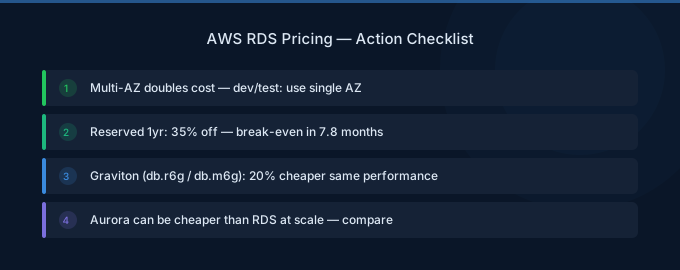
Aurora's higher per-hour instance price is misleading. Because Aurora auto-scales storage, eliminates Multi-AZ standby costs (replication is built in), and includes automated backups, the total cost is often comparable or cheaper than equivalent RDS configurations:
| Setup | RDS MySQL | Aurora |
|---|---|---|
| db.r6g.large, 500GB, Multi-AZ | $380 + $57.50 + backups = ~$450 | $211 + $50 + I/O = ~$280-350 |
Aurora wins when you have unpredictable storage needs and don't want to manage Multi-AZ separately.
Reserved Instances and Database Savings Plans
RDS Reserved Instances
Like EC2 RIs, you commit to a specific instance type for 1 or 3 years:
| Commitment | Payment | Discount |
|---|---|---|
| 1-Year No Upfront | Monthly | ~30-35% |
| 1-Year All Upfront | Lump sum | ~40-42% |
| 3-Year No Upfront | Monthly | ~45-50% |
| 3-Year All Upfront | Lump sum | ~60-69% |
A db.r6g.large at $190/month On-Demand drops to ~$59/month with a 3-year All Upfront RI — saving $131/month ($4,716 over 3 years).
Database Savings Plans (New — re:Invent 2025)
AWS launched Database Savings Plans specifically for Aurora Serverless and other serverless database workloads. They offer up to 35% savings on serverless capacity with a commitment to consistent hourly spend.
This is significant because RDS Reserved Instances don't apply to Aurora Serverless. Previously, there was no commitment discount for serverless databases.
Extended Support: The Hidden 2026 Cost Bomb
Starting March 2026, AWS charges Extended Support fees for RDS instances running end-of-life engine versions. This affects:
- MySQL 5.7: Extended Support pricing at $0.200/vCPU-hour (doubled from standard RDS pricing)
- PostgreSQL 11: Similar Extended Support surcharges
For a db.r6g.large (2 vCPUs) running MySQL 5.7, Extended Support adds $0.40/hour — $292/month on top of your existing instance cost. That's more than the instance itself.
Upgrade now or pay double: If you're still running MySQL 5.7 or PostgreSQL 11 on RDS, the Extended Support fees will likely exceed the cost of upgrading. We've helped customers migrate to MySQL 8.0 or PostgreSQL 16 in 2-4 weeks. The upgrade cost is a fraction of paying Extended Support for a year.
Cost Optimization Strategies
1. Right-Size Your Instances
Most RDS databases are over-provisioned. Check your CloudWatch metrics:
- CPU under 20% consistently → Downsize one step
- FreeableMemory over 50% → You have too much RAM
- ReadIOPS/WriteIOPS well under gp3 baseline → Don't use io1
2. Use Read Replicas Instead of Scaling Up
Instead of upgrading from db.r6g.large to db.r6g.xlarge ($190 → $380/month), add a read replica ($190/month) and route read queries to it. You get double the read capacity for the same price, plus better fault tolerance.
3. Stop Dev/Staging Databases at Night
RDS lets you stop instances for up to 7 days. A db.r6g.large stopped 16 hours/day (evenings + weekends) saves ~$127/month — 67% off. Automate this with EventBridge + Lambda.
4. Use Aurora Serverless v2 for Variable Workloads
If your database usage spikes during business hours and drops to near-zero at night, Aurora Serverless v2 scales down to 0.5 ACU ($43.80/month baseline) instead of running a fixed instance 24/7.
5. Clean Up Old Snapshots
Query your snapshots monthly and delete anything older than your retention policy. A single forgotten 1TB snapshot costs $95/month — $1,140/year doing nothing.
Related Guides
- AWS RDS Cost Optimization: Save 30-60% on DBs
- AWS Aurora Pricing Guide
- AWS DynamoDB Pricing Guide
- Savings Plans vs Reserved Instances: Which Saves More?
Frequently Asked Questions
How much does RDS cost per month?
A db.t3.micro (the smallest instance) costs ~$12/month for MySQL or PostgreSQL. A production-ready db.r6g.large with Multi-AZ costs ~$380/month instance + $57.50 storage (500GB gp3) = ~$437/month. With a 3-year RI, the same setup drops to ~$175/month. Most production databases fall in the $200-800/month range.
Is Aurora more expensive than RDS?
Not necessarily. Aurora's per-instance price is 10-20% higher, but it eliminates Multi-AZ standby costs (6-way replication is built in), auto-scales storage, and includes automated backups. For databases over 500GB with Multi-AZ requirements, Aurora is often cheaper overall.
Should I use RDS or run a database on EC2?
RDS costs 20-40% more than self-managed databases on EC2. But RDS handles patching, backups, failover, monitoring, and scaling automatically. The break-even point depends on your team's DBA capacity. If you have a dedicated DBA team, EC2 can save money. If your developers manage databases alongside their other work, RDS saves far more in engineering time than it costs.
What's the RDS free tier?
New AWS accounts get 750 hours/month of db.t3.micro Single-AZ (MySQL, PostgreSQL, or MariaDB) for 12 months. That's enough to run one small database instance 24/7. You also get 20GB of gp2 storage and 20GB of backup storage for free.
How do RDS Reserved Instances work with Multi-AZ?
You need to purchase a Multi-AZ RI specifically. A Single-AZ RI does not cover Multi-AZ deployments. Multi-AZ RIs cost roughly double the Single-AZ RI price but still save 60-69% compared to Multi-AZ On-Demand pricing. Always match your RI to your deployment type.