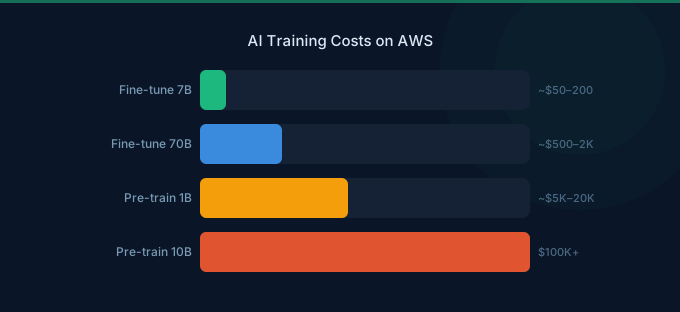
Training AI models on AWS involves far more than just GPU hours. Compute typically accounts for 70-85% of total cost, but storage, data transfer, networking, and the SageMaker management surcharge can add 15-30% on top. A fine-tuning job that appears to cost $50 in GPU time can actually cost $65-80 when you include EBS, S3, data transfer, and tooling. This guide covers every cost component for AI training on AWS, from a $50 fine-tuning job to a $500K+ pre-training run.
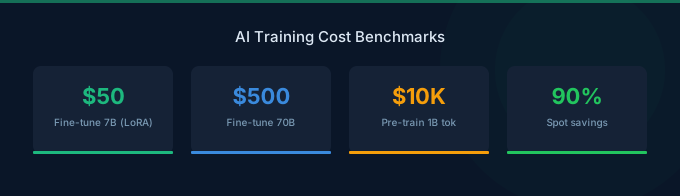
TL;DR: Fine-tuning a 7B model costs $50-200 (4-8 hours on a g5.2xlarge with Spot). Training a custom model from scratch costs $10K-100K+ depending on model size and dataset. The biggest cost levers are Spot instances (save 60-90%), right-sizing GPU instances, and using managed Spot training through SageMaker. Storage and data transfer add 10-20% to compute costs.
Training Cost Components
Every AI training job on AWS has five cost components:
| Component | Typical Share | Service | Key Cost Driver |
|---|---|---|---|
| Compute (GPU/accelerator) | 70-85% | EC2 or SageMaker | Instance type and duration |
| Storage (training data) | 5-15% | S3 | Dataset size |
| Storage (model checkpoints) | 3-10% | EBS or FSx Lustre | Checkpoint frequency and size |
| Data transfer | 2-5% | VPC, inter-AZ | Multi-node communication |
| Management overhead | 0-15% | SageMaker surcharge | Managed vs self-managed |
Compute Costs by Instance Type
Training Instance Pricing
| Instance | GPU | GPU Memory | On-Demand/hr | Spot/hr (typical) | SageMaker/hr |
|---|---|---|---|---|---|
| g5.xlarge | 1x A10G | 24 GB | $1.006 | $0.30-$0.50 | $1.41 |
| g5.2xlarge | 1x A10G | 24 GB | $1.212 | $0.36-$0.60 | $1.69 |
| g5.12xlarge | 4x A10G | 96 GB | $5.672 | $1.70-$2.84 | $7.94 |
| p3.2xlarge | 1x V100 | 16 GB | $3.06 | $0.92-$1.53 | $3.825 |
| p4d.24xlarge | 8x A100 | 320 GB | $32.77 | $9.83-$16.39 | $37.69 |
| p5.48xlarge | 8x H100 | 640 GB | $98.32 | $29.50-$49.16 | ~$113.07 |
| trn1.32xlarge | 16x Trainium | 512 GB | $21.50 | $6.45-$10.75 | $24.73 |
The SageMaker column reflects the SageMaker ML instance pricing surcharge, which adds roughly 15-40% over base EC2 pricing for managed training features.
Fine-Tuning Cost Estimates
Fine-Tuning a 7B Model (Llama 2 7B, LoRA)
| Component | Details | Cost |
|---|---|---|
| Compute | g5.2xlarge Spot, 4 hours | $1.44-$2.40 |
| EBS storage | 100 GB gp3 for model + data | $0.11 |
| S3 storage | 50 GB training data | $1.15 |
| S3 storage | Checkpoints (10 GB) | $0.23 |
| Total | $2.93-$3.89 |
For a single fine-tuning run with LoRA on a modest dataset, costs are minimal. In practice, you will run multiple experiments with different hyperparameters.
Full Fine-Tuning Cost with Experimentation
| Phase | Runs | Instance | Hours per Run | Total Cost (Spot) |
|---|---|---|---|---|
| Hyperparameter search | 10 | g5.2xlarge | 2 hrs | $7.20-$12.00 |
| Full training | 3 | g5.2xlarge | 8 hrs | $8.64-$14.40 |
| Evaluation | 3 | g5.xlarge | 1 hr | $0.90-$1.50 |
| Storage (all artifacts) | - | S3 + EBS | Monthly | $5.00 |
| Total | $21.74-$32.90 |
Fine-Tuning a 70B Model (Full Fine-Tune)
| Component | Details | Cost |
|---|---|---|
| Compute | p4d.24xlarge Spot, 24 hours | $235.92-$393.36 |
| EBS storage | 1 TB gp3 (model + optimizer states) | $2.67 |
| S3 storage | 200 GB dataset + checkpoints | $4.60 |
| Data transfer | Inter-AZ (minimal for single node) | $1.00 |
| Total | $244.19-$401.63 |
Pre-Training Cost Estimates
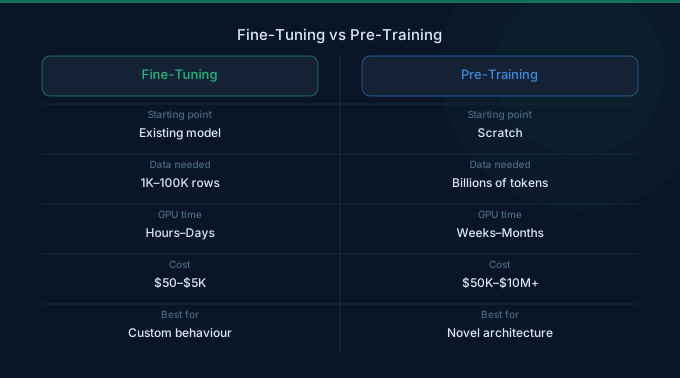
Pre-training costs scale dramatically with model size and dataset size.
Estimated Pre-Training Costs
| Model Size | Instance | Training Time | Compute Cost (On-Demand) | Compute Cost (Spot) |
|---|---|---|---|---|
| 1B parameters | p4d.24xlarge | ~3 days | $2,359 | $707-$1,180 |
| 7B parameters | 4x p4d.24xlarge | ~2 weeks | $43,869 | $13,161-$21,935 |
| 13B parameters | 8x p4d.24xlarge | ~3 weeks | $131,606 | $39,482-$65,803 |
| 70B parameters | 16x p5.48xlarge | ~4 weeks | $1,057,190 | $317,157-$528,595 |
These estimates assume training on a ~1T token dataset. Actual costs vary with batch size, sequence length, and convergence behavior.
Storage Costs for Training
S3 (Training Data and Model Artifacts)
| Storage Class | Cost per GB/month | Best For |
|---|---|---|
| S3 Standard | $0.023 | Active training datasets |
| S3 Infrequent Access | $0.0125 | Completed model artifacts |
| S3 Glacier | $0.004 | Archived checkpoints |
EBS (Attached Instance Storage)
| Volume Type | Cost per GB/month | IOPS | Best For |
|---|---|---|---|
| gp3 | $0.08 | 3,000 (base) | General training |
| io2 | $0.125 | Up to 64,000 | High-throughput data loading |
| Instance store | Included | Very high | Temporary scratch space |
FSx for Lustre (High-Performance Shared Storage)
| Configuration | Cost per GB/month | Best For |
|---|---|---|
| Persistent, 125 MB/s/TiB | $0.145 | Multi-node shared data |
| Persistent, 1,000 MB/s/TiB | $0.290 | Large-scale distributed training |
| Scratch | $0.140 | Temporary high-speed storage |
FSx for Lustre is essential for multi-node training where all nodes need fast access to the same dataset. A 1 TB persistent filesystem costs approximately $145/month.
SageMaker Managed vs Self-Managed EC2
| Feature | SageMaker Managed Training | Self-Managed EC2 |
|---|---|---|
| Compute pricing | 15-40% surcharge over EC2 | Base EC2 pricing |
| Managed Spot Training | Built-in with auto-resume | Manual implementation |
| Auto-termination | Automatic on completion | Must script yourself |
| Distributed training | Simplified configuration | Manual cluster setup |
| Experiment tracking | SageMaker Experiments | MLflow or custom |
| Typical monthly overhead | Higher compute, lower ops | Lower compute, higher ops |
When SageMaker Is Worth the Surcharge
SageMaker's surcharge pays for itself when:
- You use Managed Spot Training — SageMaker automatically handles Spot interruptions and resumes from checkpoints. Implementing this yourself on EC2 requires significant engineering effort.
- Your team lacks DevOps expertise — SageMaker eliminates cluster management, networking configuration, and scaling.
- You run many experiments — SageMaker Experiments, hyperparameter tuning, and automatic model artifact management save engineering time.
When Self-Managed EC2 Saves Money
EC2 is cheaper when:
- You have a dedicated ML platform team — The engineering cost to build and maintain training infrastructure is already amortized.
- You run long, continuous training jobs — Reserved Instance pricing on EC2 is cheaper than SageMaker's on-demand surcharge.
- You need custom environments — Complex CUDA configurations, custom kernels, or non-standard frameworks.
Spot Training Best Practices
Spot instances save 60-90% on GPU compute, but require fault tolerance.
Checkpointing Strategy
| Model Size | Checkpoint Size | Recommended Frequency | Storage Cost (S3) per Day |
|---|---|---|---|
| 1B model | ~4 GB | Every 30 minutes | $0.09 |
| 7B model | ~28 GB | Every 30 minutes | $0.64 |
| 70B model | ~280 GB | Every 60 minutes | $3.22 |
Spot Interruption Rates by Instance
| Instance | Typical Interruption Rate | Average Time Between Interruptions |
|---|---|---|
| g5.xlarge | 5-10% | 10-20 hours |
| g5.2xlarge | 5-10% | 10-20 hours |
| p4d.24xlarge | under 5% | 20+ hours |
| p5.48xlarge | under 5% | 20+ hours |
Distributed Training Costs
Multi-node training adds networking and coordination overhead.
| Configuration | Compute Cost/hr | Network Cost | Total/hr |
|---|---|---|---|
| 2x p4d.24xlarge | $65.54 | Included (EFA) | $65.54 |
| 4x p4d.24xlarge | $131.08 | Included (EFA) | $131.08 |
| 8x p4d.24xlarge | $262.16 | Included (EFA) | $262.16 |
EFA (Elastic Fabric Adapter) networking is included with P4d and P5 instances at no additional charge. The main distributed training overhead is reduced per-GPU efficiency — expect 85-95% scaling efficiency for data parallel training and 75-90% for model parallel training.
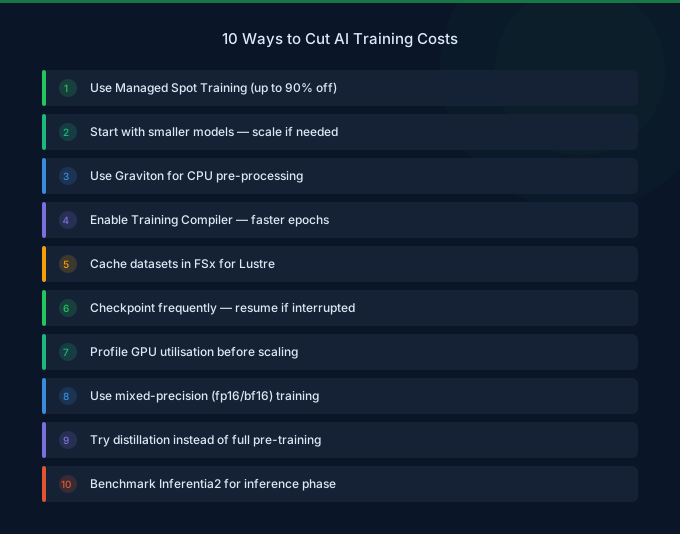
Cost Optimization Tips
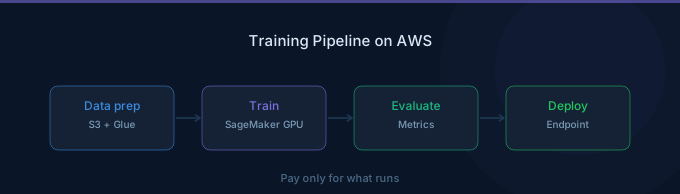
- Use Managed Spot Training through SageMaker — Save 60-90% on compute with automatic checkpoint and resume. The SageMaker surcharge is far less than the Spot savings.
- Start with LoRA or QLoRA — Parameter-efficient fine-tuning reduces GPU memory requirements by 60-80%, letting you use cheaper instances. A 7B model fits on a single g5.xlarge with QLoRA.
- Use mixed precision training (FP16 or BF16) — Reduces memory usage by 50% and speeds up training by 20-40% on modern GPUs, directly reducing your compute hours.
- Right-size your instance — Profile GPU memory usage during the first few training steps. If peak GPU memory is under 16 GB, you may be able to use a cheaper instance.
- Implement gradient checkpointing — Trades compute for memory, allowing you to train larger models on smaller GPUs. Increases training time by 20-30% but can drop you to a cheaper instance tier.
- Clean up checkpoints — Delete intermediate checkpoints after training completes. A 70B model with hourly checkpoints over a 2-week run generates ~9.4 TB of checkpoint data.
- Use FSx for Lustre for multi-node training — Shared high-performance storage eliminates the need to copy training data to each node's local storage.
Related Guides
- AWS GPU Instance Pricing Guide
- AWS SageMaker Cost Optimization Guide
- AWS Bedrock Fine-Tuning Guide
- GPU Cost Optimization Playbook
FAQ
How much does it cost to fine-tune a 7B model on AWS?
A single LoRA fine-tuning run on a 7B model costs $2-5 using a g5.2xlarge Spot instance for 4-8 hours. Realistically, with hyperparameter experimentation, expect $20-50 total. Full fine-tuning (not LoRA) of a 7B model requires more GPU memory — a p4d.24xlarge for 8-24 hours costing $80-400 on Spot.
Is SageMaker worth the extra cost for training?
SageMaker adds a 15-40% surcharge over EC2 pricing, but the Managed Spot Training feature alone can save 60-90% on compute. For most teams, the combination of Managed Spot plus automatic infrastructure management makes SageMaker net-cheaper than self-managed EC2 for training jobs.
What is the cheapest way to train a large model on AWS?
Use Trn1 instances (AWS Trainium) with Spot pricing. A trn1.32xlarge at Spot rates costs roughly $6.45-$10.75/hr — compared to $32.77/hr on-demand for a p4d.24xlarge. The tradeoff is that Trainium requires the Neuron SDK, which supports a smaller set of models and frameworks than CUDA.