What AWS credits actually are
An AWS credit is a balance that AWS attaches to an account and spends on your behalf. When the monthly invoice is generated, AWS looks at the charges the credit is allowed to cover, subtracts the credit from them, and bills you for the rest. Nothing is paid out, nothing can be withdrawn or transferred to another company, and nothing changes in how the services are metered: the usage still shows up at full price in your cost reports, followed by a negative line for the credit.
Every credit has four properties, and all four are visible in the Billing and Cost Management console under Credits: an amount, an expiry date, the list of services it can be applied to, and the account it belongs to. The amount is the headline; the other three decide how much of it you actually use. A $25,000 credit that expires in twelve months, on an account that spends $800 a month, is a $9,600 credit.
AWS issues credits for one reason: usage that starts on AWS tends to stay on AWS. A startup that builds its first product on credits keeps building there once they run out; a company that migrates with migration funding stays migrated. That is why almost every program is administered through a third party (an accelerator, an investor, an AWS partner) who brings AWS the customer, and why a partner can apply for you.
The main routes to AWS credits
“AWS credits” is not one program. It is a family of programs with different owners inside AWS, different eligibility rules and different budgets. The routes below cover almost every credit a company will ever receive.
AWS Activate, for startups
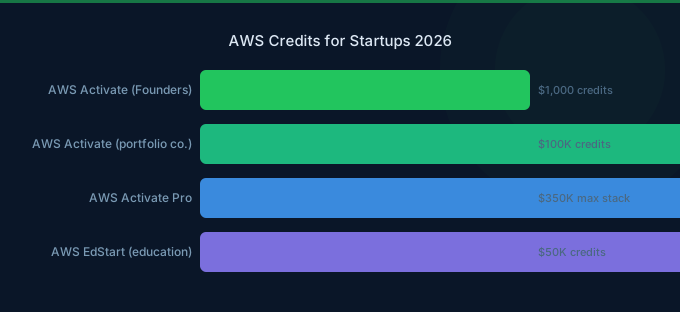
Activate is the startup program, and the route most people mean when they say “AWS credits”. It has two tiers. Activate Founders is for self-funded and very early companies: you apply directly, with basic company details and a website, and receive a small package (historically in the low four figures) with a fixed validity period. Activate Portfolio is for startups affiliated with an “Activate Provider”: an accelerator, incubator, venture fund or startup-support organization that AWS has approved. The provider gives you an organization ID to enter in the application, and the packages are far larger; the ceiling AWS publishes for Portfolio has been $100,000 for years, and our article on AWS credits for startups walks through the current tiers.
Three Activate rules matter more than the amounts. First, there is a lifetime cap on what a company can receive through Activate, and a later Activate package is offset by what you already received, so within Activate you top up to the cap rather than stack. Second, Activate credits have historically expired one to two years after issue. Third, the eligibility tests (company age, funding raised, revenue, whether you have received Activate credits before) are revised regularly, so read the terms on the day you apply rather than a year-old blog post.
Partner-sponsored proof-of-concept credits
Companies that have used up Activate, or were never eligible for it, mostly get their next credits through an AWS partner. AWS funds members of its Partner Network to run pilots, proofs of concept and architecture reviews with customers: the partner registers the opportunity with AWS, describes the workload and the AWS usage it is expected to create, and requests funding. If AWS approves, credits are issued to the customer’s account for that workload. You cannot request this funding yourself; a partner has to sponsor the application and is answerable to AWS for it, which is why the description has to be written the way AWS’s program teams expect to read it.
The Migration Acceleration Program (MAP)
MAP is for organizations moving substantial existing workloads to AWS, whether from a data center, another cloud or a hosting provider. It runs in phases (assess, mobilize, migrate and modernize) and funds each of them: partner-delivered assessment work up front, then credits released as migrated workloads go live. The credits are sized against the annual AWS usage the migration is expected to create, and AWS measures that usage through a tag (map-migrated) that has to be on every migrated resource; anything untagged does not count. MAP goes through your AWS account team and, almost always, a partner with the migration competency. It is not self-service, and it is meant for migrations large enough to justify a project plan.
ISV and AWS Marketplace programs
If you sell software to other AWS customers, a different set of programs opens up, all under the AWS Partner Network. Software partners can receive credits and funding to build, test and prove their product on AWS, co-sell with AWS’s own sales teams, and list on AWS Marketplace with private offers. The commercially important detail is on the buyer’s side: in most enterprise agreements, software bought through Marketplace counts toward the buyer’s committed AWS spend, which makes your product easier to purchase than an invoice from outside AWS.
Event, hackathon and promotional codes
The smallest route: AWS hands out credit codes at its events, hackathons, workshops and community programs, and account managers sometimes issue them as goodwill. You redeem a code in the Billing console under Credits. They are small, they expire within months, and they are often restricted to particular services. Redeem them the day you get them; do not plan around them.
Generative AI programs
Since 2023 AWS has run additional, time-boxed programs for companies building on foundation models: accelerator cohorts with larger credit packages, and credits earmarked for Amazon Bedrock, SageMaker and AWS’s own AI chips. The cohorts, the amounts and the application windows change every year, so treat any figure you read about them as dated and check the current call for applications.
| Route | Who it is for | How you get in | What to expect |
|---|---|---|---|
| Activate Founders | Self-funded, early-stage startups | Apply directly in the Activate console | Small package, fixed validity, no affiliation needed |
| Activate Portfolio | Startups backed by an approved accelerator, incubator or investor | Apply with the provider’s organization ID | Large package up to a lifetime cap; offset by earlier Activate credits |
| Partner proof-of-concept funding | Companies piloting or expanding a workload with an AWS partner | The partner registers the opportunity and requests funding | Credits for a defined workload and timeline; separate from Activate |
| Migration Acceleration Program | Organizations migrating substantial existing workloads | Through your AWS account team and a migration partner | Funding per phase; credits released against tagged, migrated usage |
| ISV and Marketplace programs | Companies selling software to AWS customers | Join the AWS Partner Network as a software partner | Build-and-test credits, co-selling, a Marketplace listing |
| Event and promotional codes | Anyone at an AWS event or in a community program | Redeem the code in the Billing console | Small, short-dated, often restricted to certain services |
What stacks with what
The question every founder asks is whether a second credit is even possible once the first one has been used. The answer depends on which budget the credits come from.
- Activate does not stack with Activate. There is one lifetime cap, and a new package is reduced by what you have already received under the program. Moving from Founders to Portfolio gets you the difference, not the sum.
- Everything else stacks with Activate. Partner-sponsored credits, MAP credits and ISV program credits are separate budgets with separate owners inside AWS. They are not reduced by Activate credits you already hold or have used, and they do not reduce a future Activate application. This is the mechanism behind Wring’s customers receiving credits “on top of our existing Activate credits”: the second credit came from a different program.
- Investor credits are usually Activate credits. Most venture funds and accelerators are Activate Providers, and the credits they arrange are Portfolio credits under the same cap. Ask which program a credit came from; it decides what you can still apply for.
- Credits stack with commitment discounts, with a caveat. A credit is applied to whatever eligible charges are on the bill, including usage billed at Reserved Instance or Savings Plan rates. Many credits exclude the upfront portion of a reservation, though, so read the credit’s terms before paying anything upfront during a credit period. Our guide to AWS commitment discounts covers how those rates work.
- Credits are shared across an organization by default. Under consolidated billing, a credit redeemed in one account is applied across the organization’s eligible usage unless credit sharing has been turned off for that account in the management account’s billing preferences. Check the setting before you redeem into a sandbox account that nobody looks at.
Expiry, and how credits appear on the bill
Credits expire, and expiry is where most of the value is lost. Every credit carries a date; whatever is unused on that date is gone, with no extension and no carry-over. Activate packages have typically run for one to two years, promotional codes for months, and MAP credits for the period agreed in the migration plan. Put the expiry dates in a calendar with a reminder ninety days out, and look at the remaining balance once a month.
On the invoice, the mechanics are simple. Usage is itemized at full price, then credits are applied to the eligible line items and shown as a negative amount. If several credits could apply, AWS draws down the one expiring soonest first. In Cost Explorer, credits appear as their own charge type; filter them out when you want to see what your architecture really costs, because a credit-funded month looks free, and “free” is a bad basis for design decisions.
What credits will not cover is set by each credit’s own terms, but the usual exclusions are AWS Marketplace purchases, AWS Support plans (unless the credit is specifically a support credit), domain registrations and, for some credits, the upfront payment on reservations. Amazon Bedrock usage, including the third-party models on it, is billed as an AWS service and has been covered by the credits Wring’s customers received; the eligible-services list on the credit itself is the final word.
The mistakes that waste credits
Letting them expire
The most common mistake, and the most expensive. Pult, an HR-tech company, had investor-provided credits expiring exactly as usage was climbing; the fix was a new application timed to land before the old credits ran out, so there was no gap at retail pricing (the Pult case study). The general rule: start the next application when the current credit has six months left, not six weeks.
Paying model vendors directly when the same models are on Bedrock
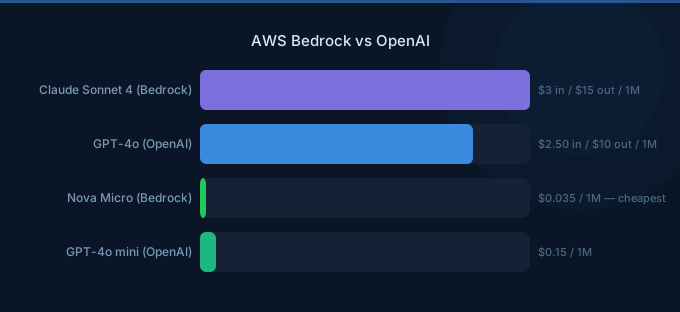
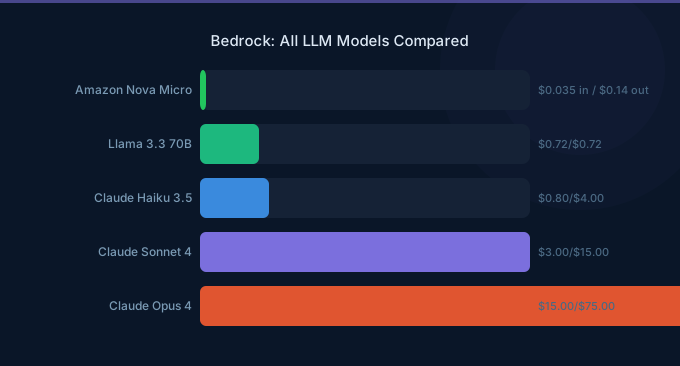
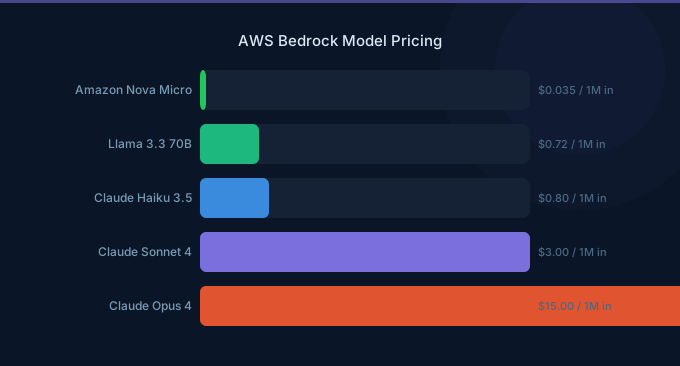
This is the largest single opportunity we see in AI companies. Kortix, an AI platform, was paying Anthropic and OpenRouter directly for Claude and other models, which meant a large and growing spend that no AWS program could touch and no credit could offset. The same models were available on Amazon Bedrock at the same per-token prices, billed through the AWS account. Moving the endpoints was a small engineering change; the spend became eligible for AWS programs, and more than $600,000 in credits landed within about 90 days (the Kortix case study). If the model you depend on is on Bedrock (our list of every Bedrock model and its cost is the place to check), paying the vendor directly is paying full price for the privilege of being ineligible. If it is not on Bedrock, none of this applies.
Designing for a credit-funded bill
A credit hides the price of your architecture for a year. Teams that treat it as free money tend to arrive at expiry with a bill that was never engineered: oversized instances, no tagging, nothing rightsized. Run the credit months with the same cost discipline you would use at retail (budgets, tags, a monthly review) and read the bill with credits filtered out. Our FinOps for startups article describes the minimum practice.
Telling the wrong story on the application
Each program funds a specific kind of usage: Activate funds a startup’s growth, proof-of-concept funding funds a defined pilot, MAP funds a migration. Applications fail when the description does not match what the program exists to pay for, when the expected usage is not credible. Partners get more applications approved because they know what AWS’s program teams expect to read, and because they are accountable to AWS for the applications they sponsor.
Applying once
Eligibility is a moving target. A funding round brings a new Activate Provider; a first enterprise customer makes you an ISV; a data-center lease ending makes you a migration. Companies that review their credit position once a year, or have a partner do it, keep finding programs. Companies that applied to Activate in year one and never again leave the larger programs untouched.
How a partner applies on your behalf
Beyond Activate Founders, almost every AWS credit program expects a sponsor: an Activate Provider for Portfolio, a partner for proof-of-concept and migration funding, the Partner Network for ISV programs. That is by design. A sponsor vouches for the workload, does the paperwork the way AWS expects it, and handles the follow-up, and AWS would rather review a well-formed application from a partner than a cold one.
Wring is an AWS Advanced Tier partner and does exactly this, for free. The sequence, as we run it: you connect read-only, billing-level access to your AWS account (nothing in your stack is touched); we check which programs your company and its usage qualify for; where a program requires it, we enroll your company in the AWS Partner Network, which changes nothing day to day; we fill in the applications as AWS expects them and handle the back-and-forth with AWS; you review and sign off. The checklist on our AWS Credits page puts your side of it at around sixteen minutes. Credits from most programs land within two to six weeks of a submitted application, following AWS’s own review process, and they stack with Activate or investor credits you already have.
What to have ready, whichever route you take: a one-paragraph description of the workload and what it does for customers; your current monthly AWS spend and a twelve-month usage estimate; the company’s founding date, headquarters, funding raised and investors; and a list of credits already received, with amounts and dates. Every program asks some version of these questions, and having them written down turns a month of back-and-forth into a week.
Why it costs nothing: Wring is paid by AWS for bringing and consolidating usage on the platform, not by you, so every dollar of credit is passed on in full. So far that has come to more than $4.5 million in credits for the companies we work with. If you want to know what you would qualify for, the one-minute savings check gives a first estimate, and the credits page explains the rest.